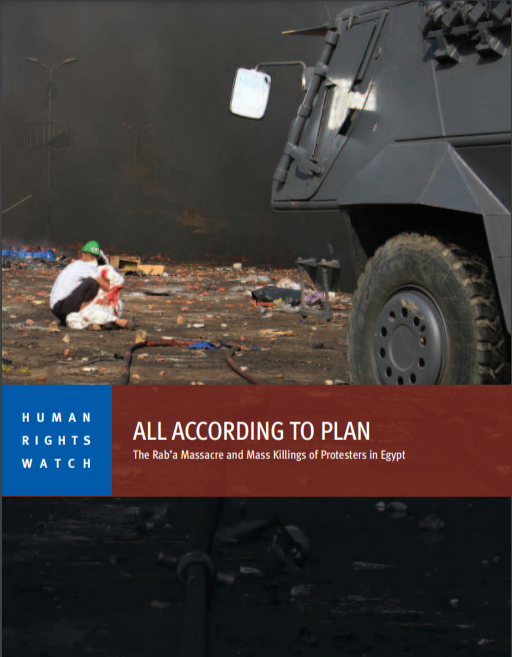
In July and August 2013, many of Egypt’s public squares and streets were awash in blood. On July 3, 2013, the military deposed Mohamed Morsy, Egypt’s first elected civilian president and a high-ranking member of the Muslim Brotherhood, on the heels of massive popular protests against Morsy calling for early presidential elections.
Over the course of the following two months, Muslim Brotherhood supporters organized two large sit-ins in Cairo and smaller protests across Egypt to denounce the military takeover and demand the reinstatement of Morsy. In response, police and army forces repeatedly opened fire on demonstrators, killing over 1,150, most of them in five separate incidents of mass protester killings.
Human Rights Watch’s one-year investigation into the conduct of security forces in responding to these Protests indicates that police and army forces systematically and intentionally used excessive lethal force in their policing, resulting in killings of protesters on a scale unprecedented in Egypt. The evidence we examined includes on-site investigations at each of the protest sites during or immediately after the attacks were underway, interviews with over 200 witnesses, including protesters, doctors, journalists, and local residents, and review of physical evidence, hours of video footage, and statements by public officials. On this basis, Human Rights Watch concludes that the killings not only constituted serious violations of international human rights law, but likely amounted to crimes against humanity, given both their widespread and systematic nature and the evidence suggesting the killings were part of a policy to attack unarmed persons on political grounds. While there is also evidence that some protesters used firearms during several of these Protests, Human Rights Watch was able to confirm their use in only a few instances, which do not justify the grossly disproportionate and premeditated lethal attacks on overwhelmingly peaceful protesters.
Numerous government statements and accounts from government meetings indicate that high-ranking officials knew that the attacks would result in widespread killings of protesters; indeed, in the single largest incident, the Rab’a and al-Nahda dispersals, the government anticipated and planned for the deaths of several thousand protesters. One year later, security forces continue to deny any wrongdoing, and authorities have failed to hold a single police or army officer accountable for any of the unlawful killings.
August 14 Rab’a and al-Nahda Square Dispersals
The gravest incident of mass protester killings occurred on August 14, when security forces crushed the major pro-Morsy sit-in in Rab’a al-Adawiya Square in the Nasr City district of eastern Cairo. Using armored personnel carriers (APCs), bulldozers, ground forces, and snipers, police and army personnel attacked the makeshift protest encampment, where demonstrators, including women and children, had been camped out for over 45 days, and opened fire on the protesters, killing at least 817 and likely more than 1,000.
Human Rights Watch researchers documented the dispersal of the Rab’a sit-in and found that security forces opened fire on protesters using live ammunition, with hundreds killed by bullets to their heads, necks, and chests. Human Rights Watch also found that security forces used lethal force indiscriminately, with snipers and gunmen inside and alongside APCs firing their weaponry on large crowds of protesters. Dozens of witnesses also said they saw snipers fire from helicopters over Rab’a Square.
While the government had declared and made public its plan to disperse the sit-ins by force, these warnings were insufficient. Government warnings in the media, and at Rab’a Square itself, in the days before August 14 failed to specify when the dispersal would take place. Warnings on the morning of the dispersal were not heard by many and did not provide protesters sufficient time to leave before security forces resorted to forcible dispersal. The vast majority of the demonstrators interviewed by Human Rights Watch in connection with this event said they did not hear the looped pre-recorded warnings security forces played over loudspeakers near at least two of the entrances to the sit-in minutes before opening fire. Security forces then besieged demonstrators for most of the day, attacking from each of the five main entrances to the square and leaving no safe exit until the end of the day, including for injured protesters in need of medical attention and those desperate to escape. Instead, in many cases security forces fired on those who sought to escape, witnesses told Human Rights Watch.
The indiscriminate and deliberate use of lethal force resulted in one of the world’s largest killings of demonstrators in a single day in recent history. By way of contrast, credible estimates indicate that Chinese government forces killed between 400-800 protesters largely over a 24-hour span during the Tiananmen Massacre on June 3-4, 1989, and that Uzbek forces killed roughly similar numbers in one day during the 2005 Andijan Massacre.
The dispersal of the Rab’a Square sit-in lasted 12 hours, roughly from sunrise to sunset. Police commenced their assault, in coordination with army forces, at around 6:30 a.m. by lobbing teargas canisters and shooting birdshot pellets at protesters located near the entrances to the square. They quickly, within minutes at some entrances, escalated to live fire, according to dozens of witnesses. Led by army bulldozers, police slowly advanced from each of the five major entrances to the square—two on Nasr Street, two on Tayaran Street, and one on Anwar al-Mufti Street behind the Rab’a al-Adawiya Mosque—in the early morning hours, destroying makeshift fences erected by protesters and other structures in their path. The advancing forces were supported by snipers deployed on top of adjacent government buildings. Many protesters retreated to the central area of the square for safety, but some remained on the peripheries to hurl stones, Molotov cocktails, and fireworks at advancing forces.
Injured and dead protesters quickly filled the Rab’a hospital and makeshift facilities across the square, where volunteer doctors and other medical professionals, many themselves demonstrators, tended to serious injuries using basic donated equipment and medicine. Doctors in Rab’a hospital told Human Rights Watch that the vast majority of injuries they treated were gunshot wounds, many to the head and chest. Security forces from the morning fired at makeshift medical facilities and positioned snipers to fire on those who sought to enter or exit Rab’a hospital.