
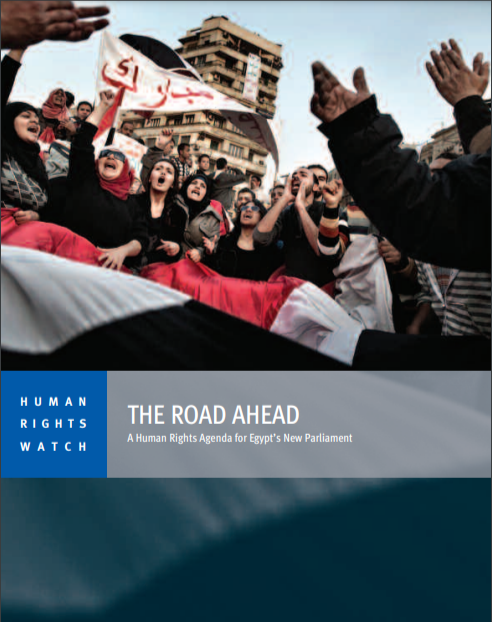
Egypt’s newly elected parliament will bear a heavy responsibility for reform. The break from Mubarak’s abusive rule that Egyptian protesters called for last year has not taken place, and Egypt has yet to see a transition from the military regime, which was the backbone of Mubarak’s rule. Over the past year, Egyptians have experienced many of the same human rights abuses that characterized Mubarak’s police state. Under the leadership of the Supreme Council of the Armed Forces (SCAF), excessive use of force, torture, attacks on peaceful protests, and arbitrary arrests of peaceful protesters, bloggers, and journalists have become commonplace and illustrate how little has changed. Ending these abuses will only occur when there is political will to break with the past and truly reform the country’s oppressive machinery.
With a new parliament, Egypt will, for the first time in many decades, have a fairly and freely elected civilian body.
But a genuine transition in Egypt from authoritarian government to a more open system with democratic institutions not only requires reforms of democratic institutions and electoral procedures, but of laws and policies that govern the civil and political rights and freedoms of people in Egypt.
First and foremost, this must include the abolition of the Emergency Law and revision of the police law that allows Egyptian police wide latitude to shoot Egyptians, including those who assemble in public and on the country’s borders. Second, this must include amendments to the Code of Military Justice to restrict its jurisdiction to military offenses perpetrated by military officers, and an end to civilian trials before military courts. Third, this must include reforms of the legislative framework that governs freedom of expression, association, and assembly that are essential to creating the political space for Egyptian political parties, civil society, activist groups, and media to receive and share information and views, including controversial and political ones, and participating in a meaningful democratic process, including in the upcoming elections. Fourth, it must include amending the Penal Code’s definition of torture so that it accords with international law and covers all forms of physical and psychological abuse. Finally, it must include strengthening penalties for police abuse so that they serve as effective deterrents.
This report focuses on laws that are incompatible with the enjoyment of the basic rights affirmed in the International Covenant on Civil and Political Rights (ICCPR), which Egypt ratified in 1982, and the African Charter on Human and People’s Rights, which it ratified two years later. Egypt’s parliament should prioritize a full review and reform of these laws.